Giant resin bee

Scientific name: Megachile sculpturalis

Size: 14-27 mm

Name (ES): Abeja gigante de la resina

Origin: Eastern Asia, Japan, China, Korea and Taiwan

Description:

Detected in the Balearic Islands in 2021.

This insect presents opportunistic nesting behaviour and makes holes in the trunks of dead or alive trees. Adult females use pre-existing nests from other native insects, such as reeds, holes or artificial structures. It is commonly found in exotic ornamental, fabaceous and leguminous trees such as Sophora japonica. It was included in the 2019 IUCN Invader List.

You can download this informative poster

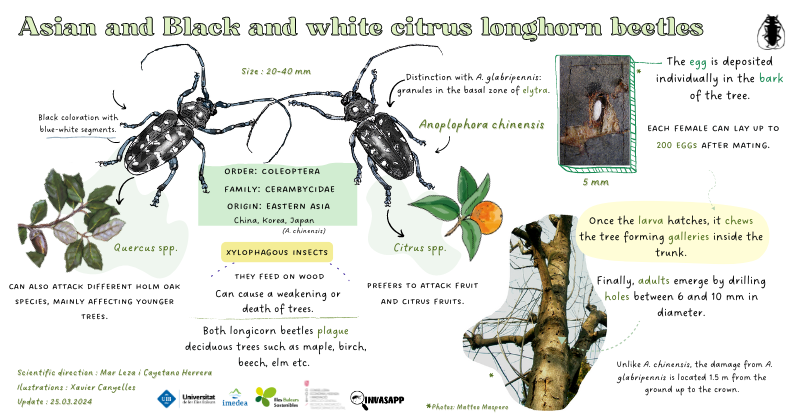
Asian and Black and white citrus longhorn beetles

Photograph author: Matteo Maspero

Photograph author: Matteo Maspero

Scientific name: Anoplophora glabripennis & Anoplophora chinensis

Size: 20-40 mm

Origin: Eastern Asia, China, Korea and Japan (A. chinensis)

Name (ES): Escarabajo asiático de cuernos largos y escarabajo de cuernos largos de los cítricos

Differentiation: A. chinensis has granules in the basal zone of elytra.

The egg is deposited individually in the bark of the tree and each female can lay up to 200 eggs after mating. Once the larva hatches, it chews the tree forming galleries inside the trunk. Finally, adults emerge by drilling holes between 6 and 10 mm in diameter. Unlike A. chinensis, the damage from A. glabripennis is located 1.5 m from the ground up to the crown.

Both longicorn beetles are xylophagous insects, meaning they feed on wood and can cause a weakening or death of trees. In their home region, they plague deciduous trees such as maple, birch, beech, elm etc. However, A. glabripennis can attack different holm oak species (Quercus spp.), mainly affecting younger trees. A. chinensis prefers to attack fruit and citrus fruits.

Image author: Matteo Maspero

You can download this informative poster

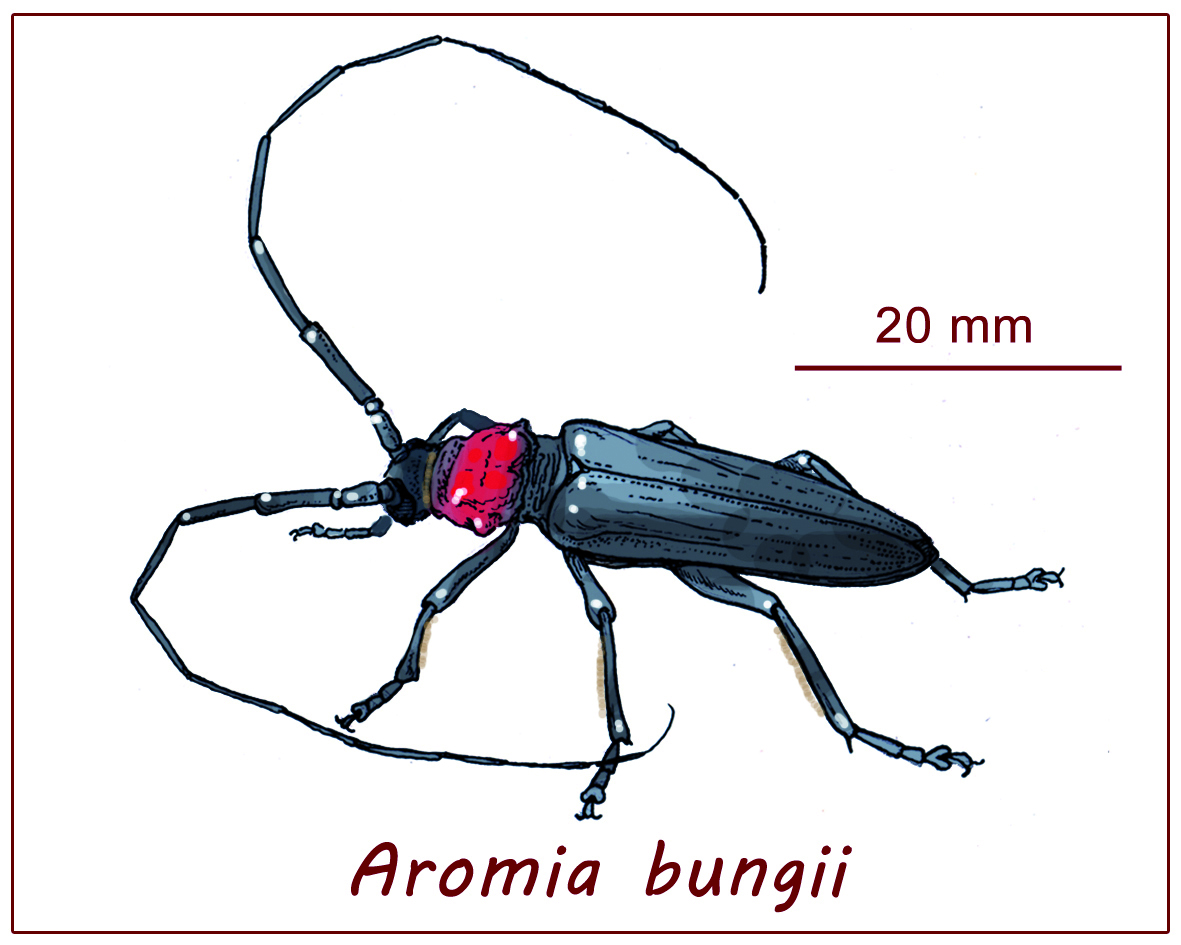
Red necked longicorn

Photograph author: Pierre Haller

Scientific name: Aromia bungii

Size: 22-38 mm

Origin: China, Mongolia, South and North Korea, Taiwan and Vietnam

Name (ES): Escarabajo cuellirojo de cuernos largos

Description:

A xylophagous insect with a limited range of hosts, it attacks species of the Prunus spp. genus, i.e. cherry, plum, almond, apricots, nectarines etc. Surveys must be carried out on the main entrance routes to detect these pests, such as host plants used in plantations and Prunus spp. wood.

Image author: Antonio P Garonna

You can download this informative poster

Bronze birch and emerald ash borers

Scientific name: Agrilus anxius i Agrilus planipennis

Size: 8-14 mm

Origin: North America (A. anxius) and North-Eastern Asia (A. planipennis)

Name (ES): Barrenador del abedul y barrenador esmeralda del fresno

Description:

Chilean beetles can attack trees in both forests and crops. 

Females lay eggs in tree bark cracks, larvae develop and feed on the inner bark and trunk cambium, causing damage to the main trunk and larger branches. Finally, they emerge as adults after one or two years.

These borers are a serious pest in birch (Betula pendula and B. pubescens) and ash (Fraxinus spp.) Although damage may be mild in their area of natural origin, European species can be extremely susceptible.

You can download this informative poster

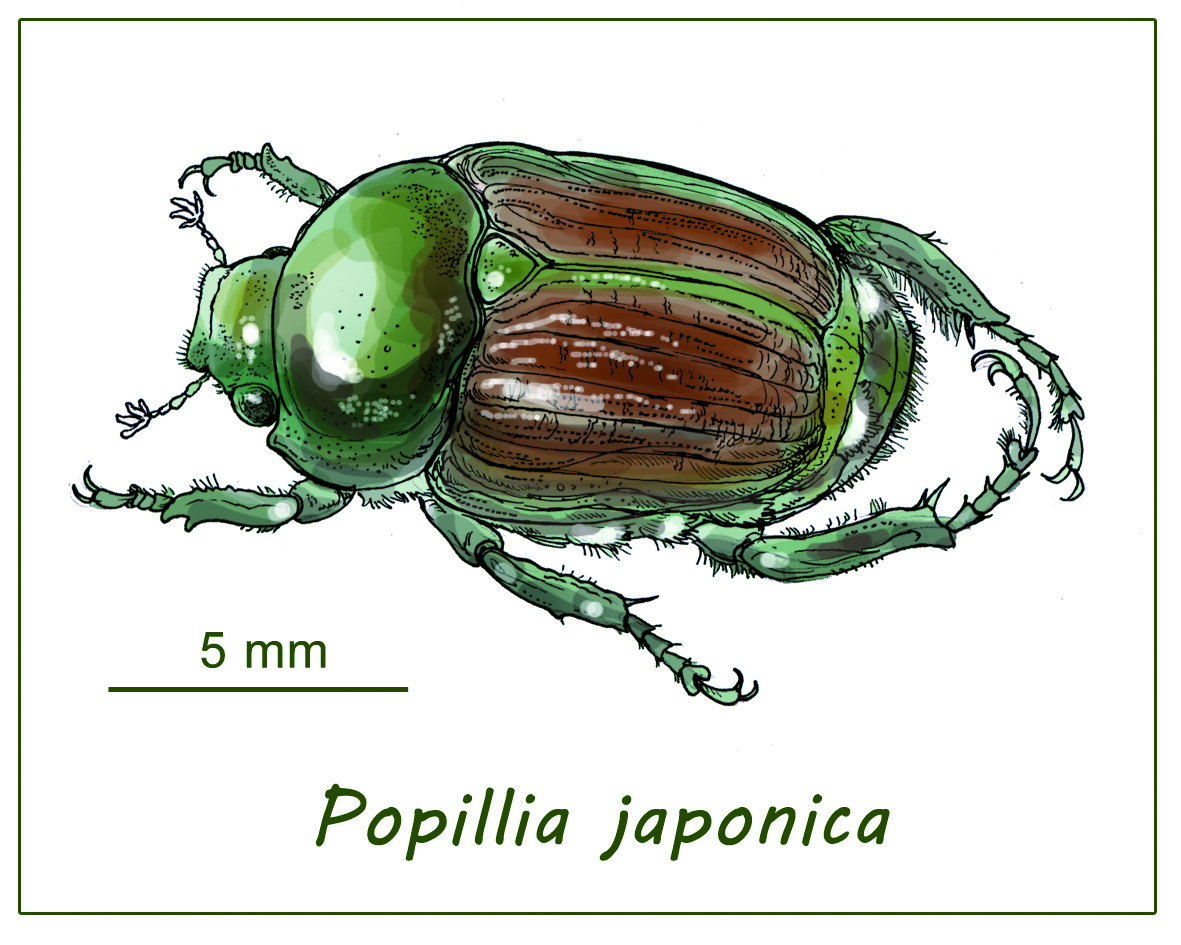
Japanese beetle

Scientific name: Popillia japonica

Size: 8-11 mm

Origin: Japan

Name (ES): Escarabajo japonés

Description:


A highly polyphagous and gregarious pest, it can feed on more than 700 species of plants. Adults are defoliators and can skeletonise leaves and feed on fruits. They attack trees, fruit trees, berries, crops, ornamental plants and shrubs. The larvae consume roots, reducing the root system of grasses and vegetables. It is the most widespread grass pest in the United States.

You can download this informative poster